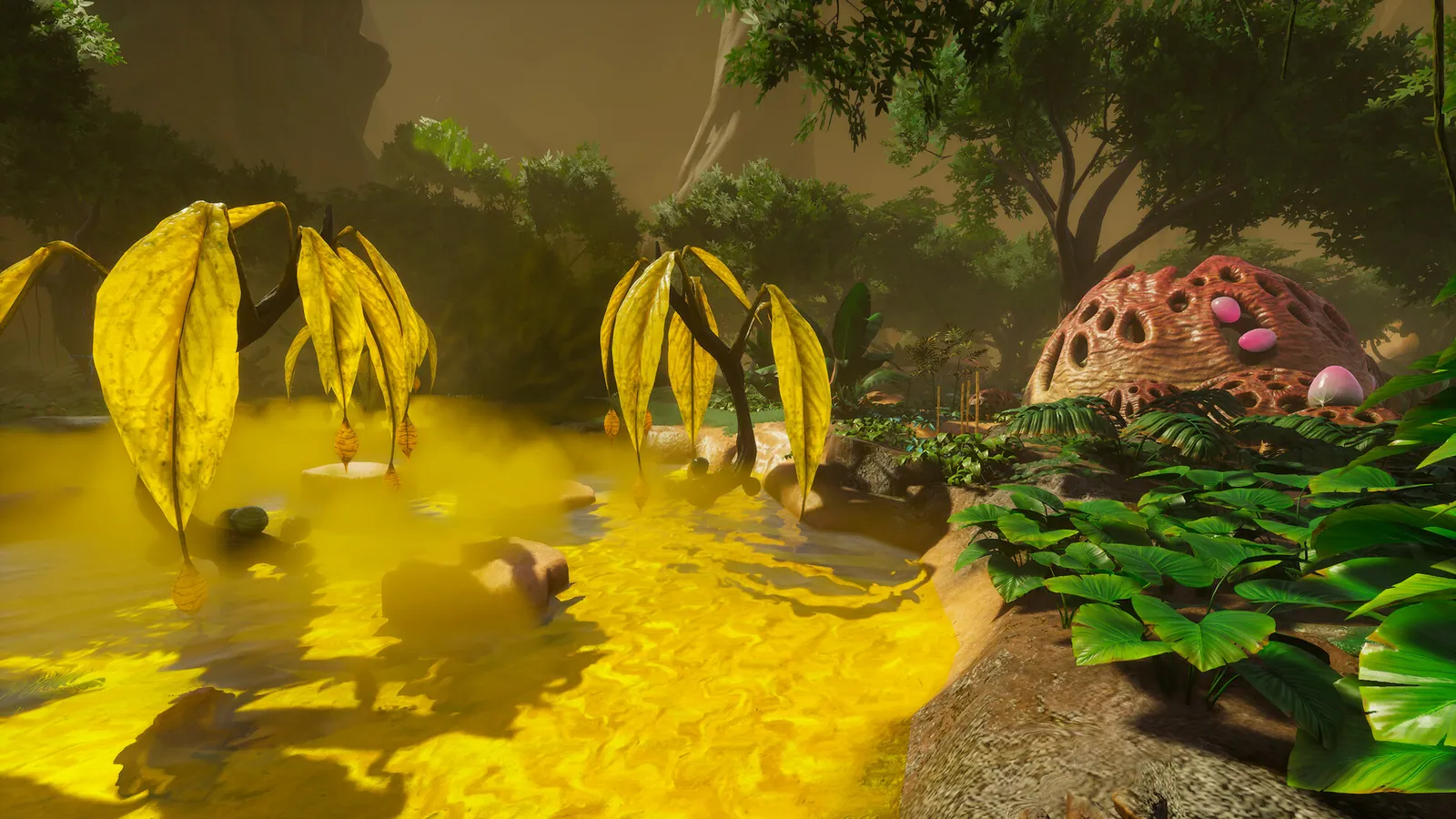
Infection in Blind Descent is a condition the environment applies to a character, not a wound a single creature inflicts. It accumulates while the team is exposed, the HUD announces it before the effects are obvious, and it is cleared by a consumable rather than cured permanently.
The Infection Suppressor is the answer, and it is a supply problem rather than a skill problem: made at a Medical Station from an Infection Heart and Emberleaf, it clears infection and grants brief immunity, which is long enough to leave a bad area and not long enough to live in one.
The place is the vector
Most survival games treat a status effect as the residue of a fight. This one treats the ecosystem as the cause: the underground is a living system with its own weather, its own growth, and its own ideas about what belongs in it, and exposure is enough to accumulate infection.
That matters tactically because it removes the usual reset. Killing everything nearby does not make an area clean, and an area that was safe on the way in can be worse on the way out if the route passed through growth. The threat is spatial, and it is attached to where a player stands rather than to what a player is fighting.
It also means the counter is preparation. A team that budgets suppressors per trip, the way it budgets food or arrows, spends the trip making decisions. A team that carries one spends the trip looking for the exit.
The HUD speaks before the body does
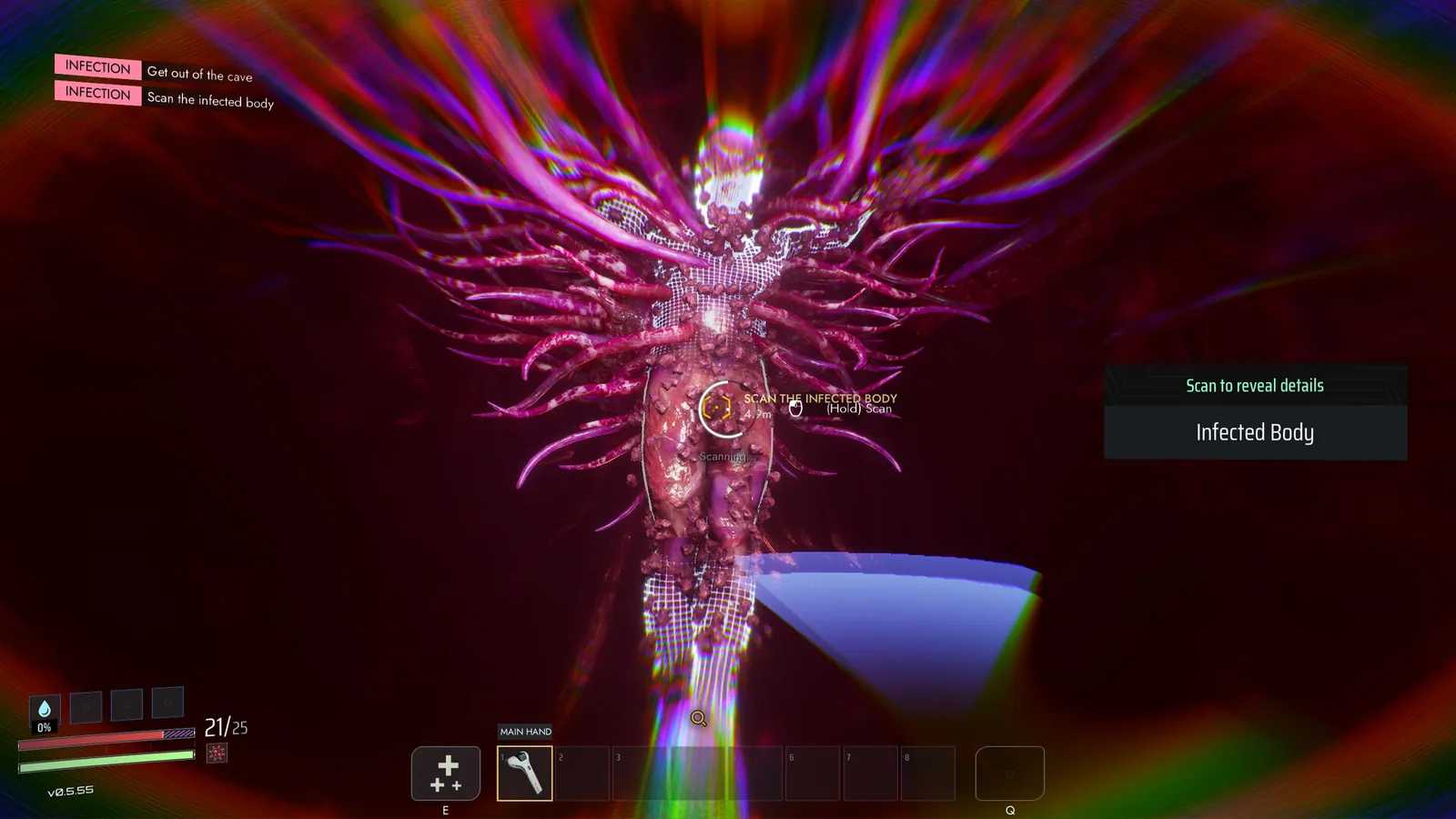
Infection announces itself on screen. A banner reading INFECTION! fires when the condition applies, and it is easy to read as ambient noise in the first hour because nothing visibly happens at once. It is not noise — it is the game telling you the meter has moved and the cause is still around you.
The same screen offers the diagnostic: infected bodies can be scanned, and the prompt reads [HOLD] SCAN with the target named underneath. Scanning one is how the state gets a shape — what it looks like, what it does to a body, and which parts of the environment produce it.
The warning and the scan belong together. One tells you that you are in it; the other tells you what it is. Neither is optional if the plan is to spend more than an hour underground.
What the suppressor actually buys
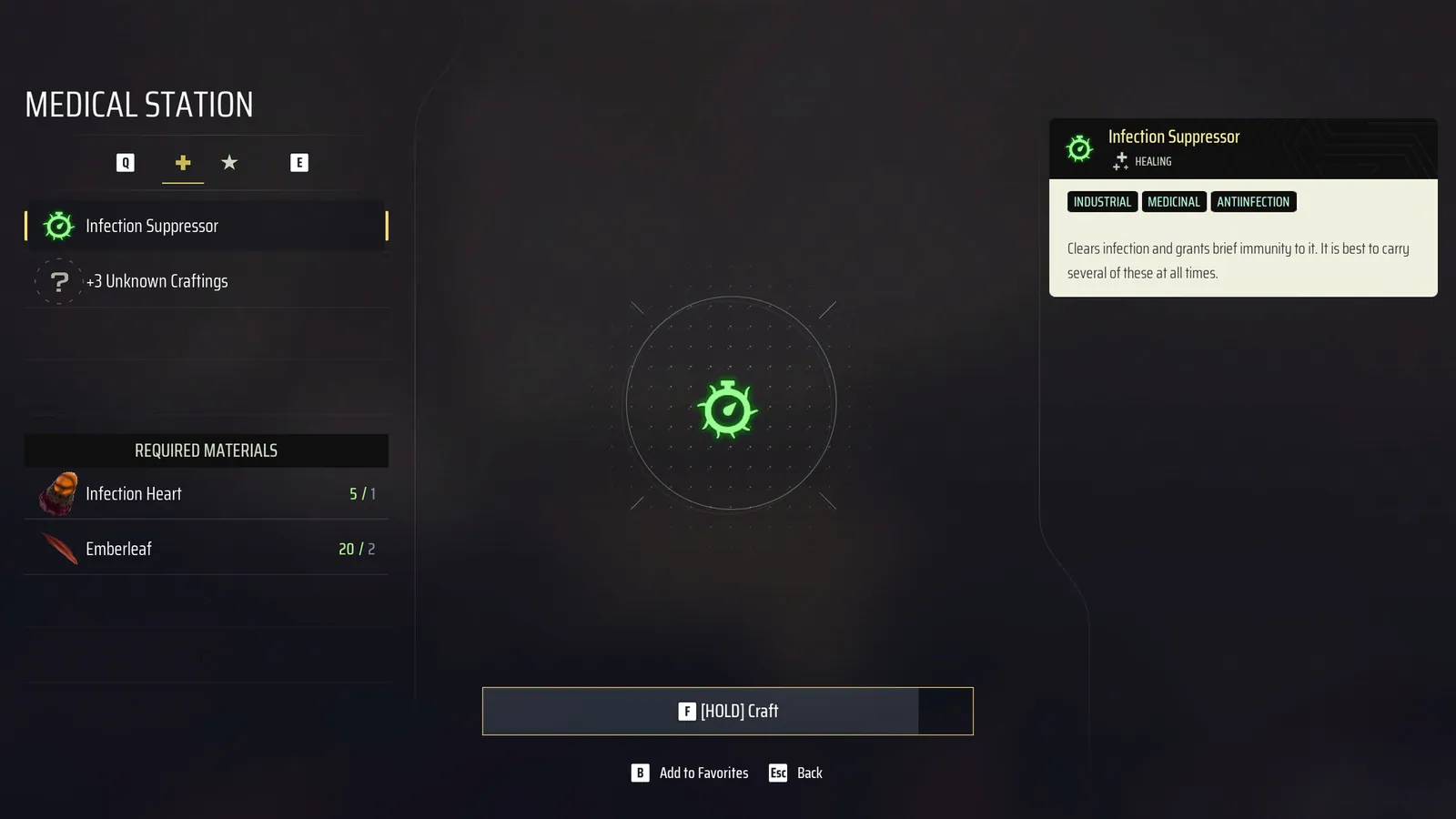
The Medical Station handles the medical line, and the suppressor is a fixed recipe rather than an assembly: Infection Heart plus Emberleaf, with a description that does exactly what it says. It clears infection and grants brief immunity.
Two words in that description do all the work. Clears means the meter resets, so the suppressor is a way out of a state rather than a way to avoid one. Brief means the immunity is a window for movement — enough to cross a contaminated stretch, leave a choked room, or finish an interaction that cannot be abandoned halfway.
The third detail is the quantity. The item's own text says it is best to carry several at all times, which is the game telling you that one is not a plan. Suppressors are consumables with two inputs, and both inputs come from the same ecosystem that applies the infection, so the stock is always slightly behind the need.
| Situation | Spend one | Ride it out |
|---|---|---|
| Crossing a contaminated stretch with a destination in mind | Yes — the immunity covers the crossing | No, unless the route is short and known |
| Infection climbing while the team is still looting | Yes | No, the trip is already long |
| A single spike near the base entrance | No | Yes, if a station and materials are close |
| Deep in unexplored ground with no route back | Yes, and turn around | No, running out mid-route is the run |
Mutation is a different contract
Infection and mutation are related but not the same decision. Infection is something the environment does to a character. Mutation is something a character can accept: symbiosis with the ecosystem grants new abilities and changes how the character looks.
The price is stated as a cost and left there. Symbiosis is not a free upgrade tree, and the abilities it grants come attached to a body that is no longer entirely the team's own. That is a narrative line as much as a mechanical one, and it is the reason the game offers a second path: staying human through science and tools.
The science path is the slower one and the one the base supports. Stations, crafted gear and a maintained facility are what allow a run to keep going without taking the bargain, and the appeal of that route is that nothing is owed at the end of it. Crafting is where most of that resistance is actually built.
Neither path is a trap and neither is obviously correct. What matters is choosing deliberately rather than drifting into mutation because the meter was full and the suppressor was in the base.
Deciding in the moment
The judgment call is simple to state and hard to make under pressure: a suppressor is worth spending when the next thirty seconds matter more than the next thirty minutes.
Spend it when the immunity window covers a specific piece of movement — a crossing, a retreat, a climb out of a bad room. Spend it when infection is climbing during a fight that cannot be disengaged, because a dead character carries nothing home.
Hold it when the base is close, when the meter is low and stable, and when the team is about to leave anyway. Hold it, most of all, when the alternative is spending the last one to save two minutes of walking.
The failure mode is not running out. It is running out in the wrong place: deep in unexplored ground, with a route back that passes through everything that caused the problem. Suppressors are cheap compared with an expedition, and the players who treat them as expensive are the ones who lose the gear they were carrying.
Does the suppressor cure infection permanently?
No. It clears the current infection and grants brief immunity to it, so the exposure clock starts again once that immunity ends.
Where is the suppressor made?
At a Medical Station, as a fixed recipe rather than an assembled tool. The materials are an Infection Heart and Emberleaf.
How many should I take on a trip?
Several. The item description recommends carrying multiple at all times, and the environment keeps applying infection for as long as a character is exposed.
Is mutation required to progress?
No. Symbiosis is one route and it grants abilities at a cost; staying human through science and tools is the other, and both are available.
The two systems that surround this one are the base that keeps the stock coming and the wildlife that decides how long a trip lasts. Base building covers the first, and the biomes overview covers the places that apply the pressure hardest.